Secure Business Phone System: What It Actually Takes in 2026
What makes a secure business phone system in 2026? See the encryption standards, threats, and checklist to protect your calls, plus eFone's security approach.
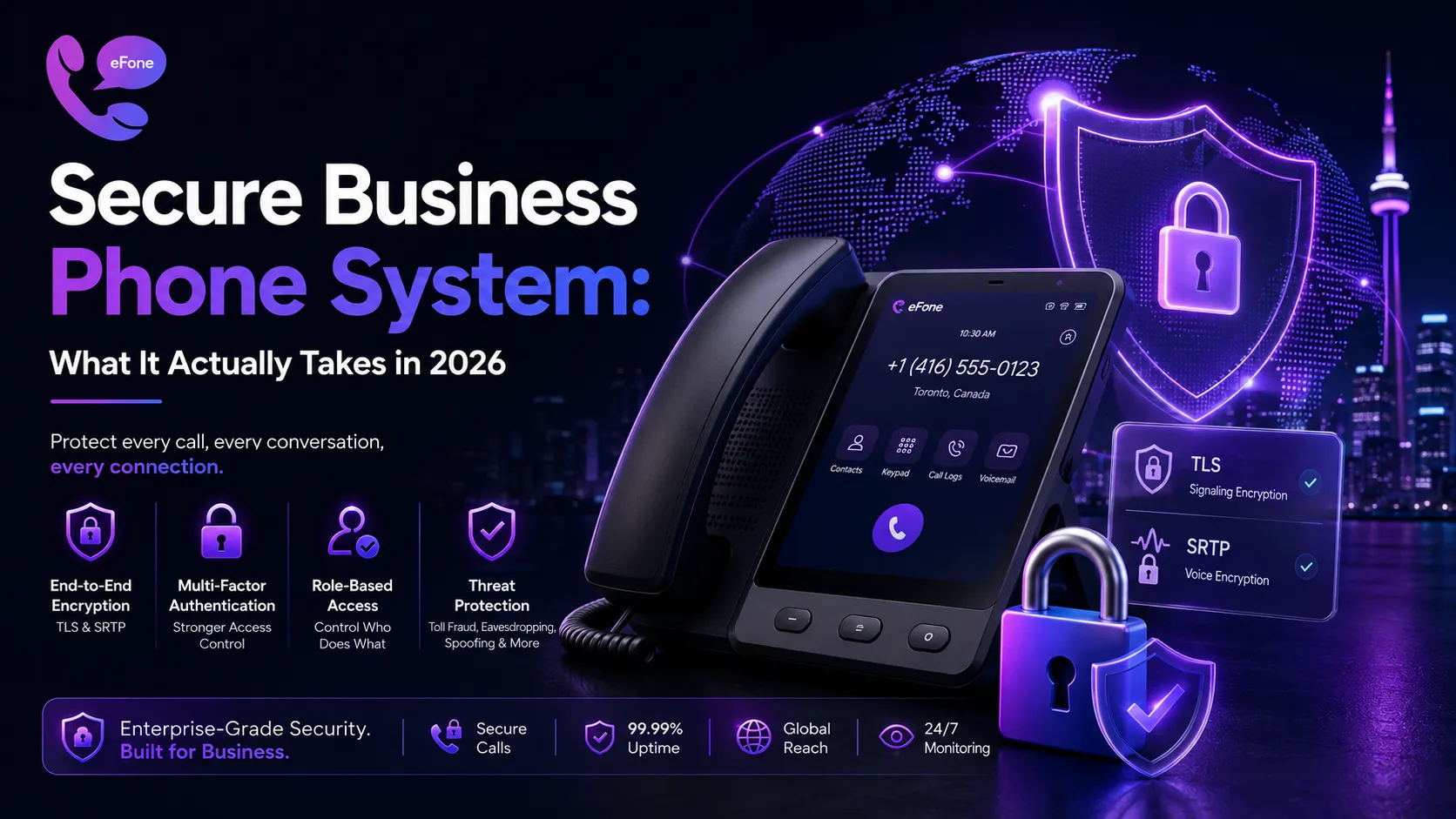
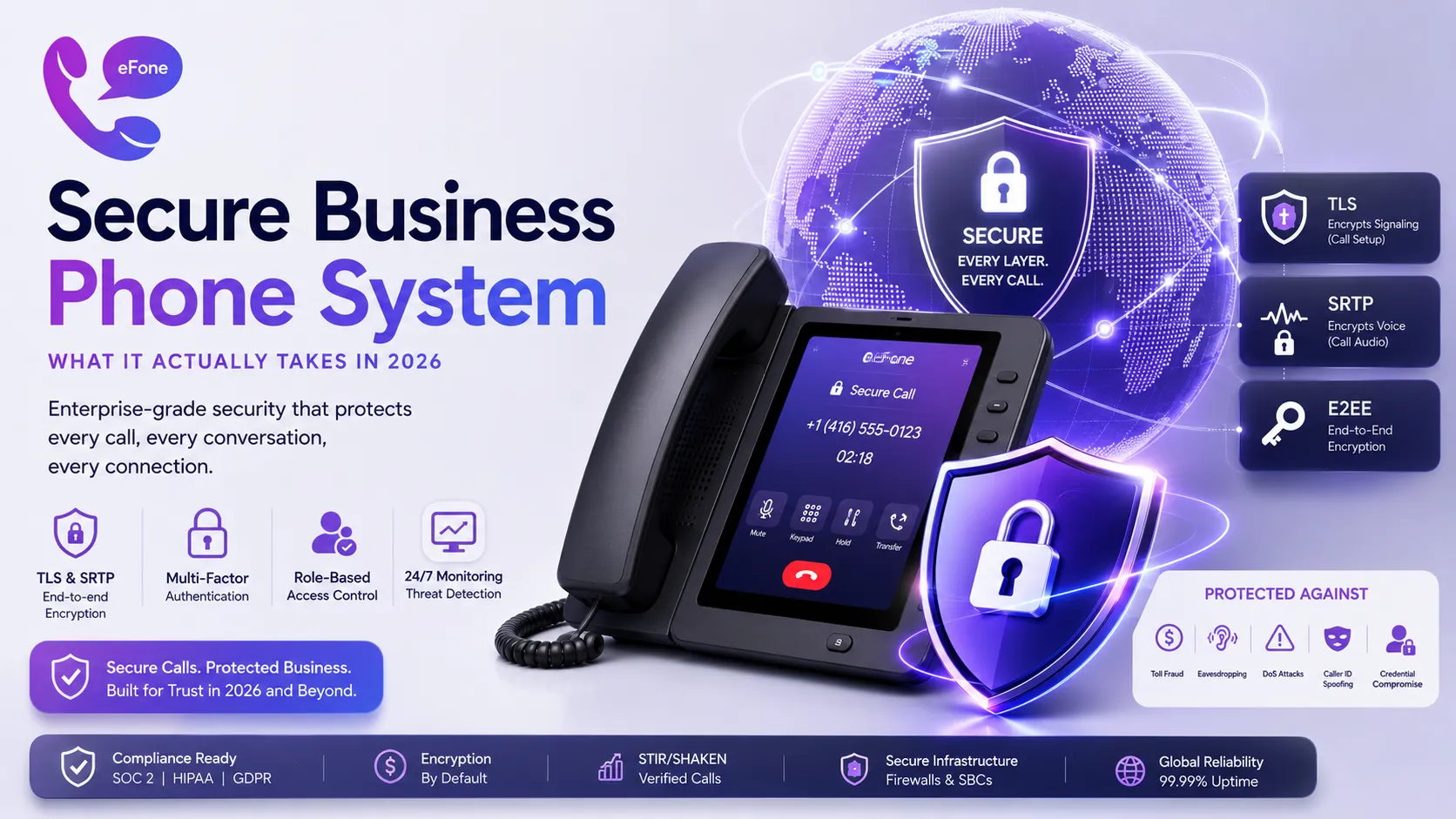
A secure business phone system protects calls in two places: while they're signaling (call setup, caller ID, routing) and while they're carrying actual voice audio. That means two encryption standards working together, TLS for signaling and SRTP for the voice media itself, plus account-level protections like multi-factor authentication and role-based access. Skip either encryption layer and calls can still be intercepted even if the rest of the system looks secure. Here's what a properly secured VoIP system includes, the threats it defends against, and how to evaluate a provider.
Why VoIP Security Is a Bigger Deal Than It Used to Be
Traditional landlines ran on dedicated copper wiring that was hard to intercept without physical access. VoIP calls travel over the same internet connection as everything else your business does, which means they inherit internet-scale risks: unauthorized access, denial-of-service attacks, and remote interception. Remote and hybrid work has widened this further, since employees now connect from home networks and personal devices that are harder to standardize and secure than a single office network.
The Core Encryption Standards Every Business Phone System Needs
TLS (Transport Layer Security)
TLS encrypts the signaling layer, the setup information like caller ID, phone numbers, and call routing instructions. Without it, this metadata can be intercepted or tampered with even if the conversation itself is protected.
SRTP (Secure Real-Time Transport Protocol)
SRTP encrypts the actual audio of the call. A provider offering TLS without SRTP is only protecting the call setup, the conversation itself would still travel in plaintext, meaning eavesdroppers could listen in directly.
End-to-end encryption (E2EE)
Standard TLS/SRTP typically encrypts client-to-server, meaning the provider's servers can technically access unencrypted data in transit. True end-to-end encryption uses keys that prevent even the provider from accessing call content, which matters most for businesses handling highly sensitive conversations.
When evaluating a provider, ask directly whether TLS and SRTP are mandatory on every call by default, or whether they're optional settings that need to be manually enabled. A meaningful share of VoIP security incidents come down to encryption that was available but never turned on.
Common VoIP Security Threats
- Toll fraud: Attackers gain unauthorized access to a phone system and place large volumes of expensive international calls, sometimes racking up tens of thousands of dollars before anyone notices. This is consistently one of the most financially damaging VoIP-specific threats.
- Eavesdropping: Unencrypted calls can be intercepted and recorded by anyone with access to the network path the call travels through, a direct consequence of skipping SRTP.
- Denial-of-service (DoS) attacks: Attackers flood a VoIP system with traffic to disrupt service, which can take a business's entire phone system offline during the flood.
- Caller ID spoofing: Attackers fake caller ID information to impersonate trusted numbers, often as a setup for social engineering or phishing attempts against employees.
- Credential compromise: Weak passwords on admin portals or user accounts give attackers a direct path into call routing, voicemail, and account settings.
A Practical Security Checklist for Choosing a Provider
- Confirm TLS and SRTP are mandatory on every call, not optional add-ons.
- Ask whether end-to-end encryption is available for sensitive communications.
- Require multi-factor authentication on all admin and user accounts.
- Check for role-based access controls that limit who can change routing, billing, or recordings.
- Ask about STIR/SHAKEN support, which helps prevent caller ID spoofing at the carrier level.
- Look for relevant compliance certifications (SOC 2, HIPAA, GDPR) if your industry requires them.
- Confirm the provider offers 24/7 monitoring or anomaly detection for unusual calling patterns, which is often how toll fraud is caught early.
- Ask how firewalls and session border controllers (SBCs) are used to filter and monitor VoIP traffic.
What Businesses Can Control on Their Side
Provider-side security only covers half the equation. Internal practices matter just as much:
- Restrict international calling permissions to only the extensions that genuinely need them.
- Require strong, unique passwords and enforce MFA for every employee with system access.
- Secure home and remote work networks with basic protections like VPN access where appropriate.
- Review call logs periodically for unusual patterns, especially international or after-hours calling spikes.
- Limit admin-level access to a small, defined group rather than the whole team.
Security for Regulated Industries
Businesses in healthcare, legal, and financial services face additional requirements on top of general VoIP security. HIPAA-covered practices need business associate agreements and encrypted call recording where applicable. Financial services firms often need to meet standards like SOC 2 or FINRA-aligned recordkeeping. If your business falls into a regulated category, confirm compliance certifications directly with any provider before signing, general-purpose security claims aren't the same as certified compliance.
Where eFone Fits
eFone applies TLS and SRTP encryption across calls by default rather than as an optional setting, alongside multi-factor authentication and role-based admin access, so security isn't something your team has to configure correctly on day one. You can see more about eFone's plans on the efone pricing page.
If your business has specific compliance needs, our guide to call recording software covers recording and retention considerations, and our VoIP for call centers guide addresses security at higher call volumes.
The Bottom Line
A secure business phone system isn't a single feature, it's a combination of mandatory call encryption, account-level protections, and provider transparency about what's actually turned on by default. Ask direct questions before you sign with any provider, and treat security review as an ongoing practice rather than a one-time checkbox. See how eFone approaches security as part of its standard plans.
Frequently Asked Questions
What makes a business phone system secure?+
A secure business phone system uses TLS to encrypt call signaling and SRTP to encrypt voice audio, combined with multi-factor authentication, role-based access controls, and monitoring for unusual calling activity.
Is VoIP less secure than a traditional landline?+
VoIP introduces internet-based risks that landlines don't have, such as remote interception or denial-of-service attacks, but a properly configured VoIP system with mandatory encryption is generally considered secure for standard business use.
What is toll fraud in VoIP?+
Toll fraud occurs when attackers gain unauthorized access to a phone system and place large volumes of expensive international calls, sometimes resulting in tens of thousands of dollars in charges before detection.
What's the difference between TLS and SRTP?+
TLS encrypts the signaling layer, call setup data like caller ID and routing information. SRTP encrypts the actual voice audio of the call. Both are needed for a fully encrypted call.
Is end-to-end encryption the same as standard VoIP encryption?+
No. Standard TLS/SRTP typically encrypts data between the client and the provider's servers, while true end-to-end encryption prevents even the provider from accessing call content.
How do I know if my VoIP provider encrypts calls by default?+
Ask directly whether TLS and SRTP are mandatory on every call or optional settings. Many VoIP security gaps come from encryption that's available but not enabled by default.
What is caller ID spoofing?+
Caller ID spoofing is when attackers fake caller ID information to impersonate a trusted number, often used to support phishing or social engineering attempts against employees.
What is STIR/SHAKEN?+
STIR/SHAKEN is a caller ID authentication framework that helps verify a call's origin and reduce caller ID spoofing at the carrier level.
Do I need HIPAA-compliant VoIP for a medical practice?+
Yes, if your practice transmits protected health information over calls, voicemail, or recordings, you need a provider willing to sign a business associate agreement and support HIPAA-required safeguards.
Can VoIP calls be hacked?+
Yes, if security measures like encryption and strong authentication aren't in place. Common risks include eavesdropping, toll fraud, and credential compromise on admin accounts.
What is a session border controller (SBC)?+
An SBC is a network security device that monitors and controls VoIP traffic at the edge of a network, helping filter malicious traffic before it reaches your phone system.
Should remote workers use VPNs for VoIP calls?+
It depends on the sensitivity of the calls and the security of the remote worker's home network, but a VPN adds a meaningful layer of protection for businesses handling sensitive communications remotely.
How often should I review VoIP security settings?+
VoIP security isn't a one-time setup, reviewing call logs, access permissions, and international calling restrictions periodically (at least quarterly) helps catch issues before they escalate.
What compliance certifications should I look for in a VoIP provider?+
SOC 2 is a common baseline signal of security practices, with HIPAA, GDPR, or FINRA-aligned certifications relevant depending on your industry and the sensitivity of the data you handle.
Does encryption slow down call quality?+
No. Modern encryption standards like TLS and SRTP are designed to run with minimal performance impact, and any call quality issues are almost always related to internet bandwidth rather than encryption overhead.
Ready to get your number?
Set up a business phone and help desk on one account, or grab a personal line to call home — usually in minutes.
Get started