
Phone System ROI: How to Calculate What Your System Is Really Worth
Learn how to calculate phone system ROI with a simple formula, a worked example, and the hidden savings most businesses forget to count.
Phone system ROI is calculated as (Total Gains minus Total Costs) divided by Total Costs times 100, where gains include both hard savings (lower monthly bills, eliminated hardware) and softer productivity benefits (faster calls, fewer missed leads, less IT time). Most businesses that switch from a legacy system to cloud VoIP see a positive ROI within 3 to 6 months. Here is exactly how to run the numbers for your own team, plus a worked example you can copy.
The Phone System ROI Formula
At its simplest, phone system ROI uses the standard investment formula: ROI = (Total Gains minus Total Costs) divided by Total Costs times 100.
For example, if your phone system costs $500/month and it saves or generates $1,500 in value over that same month, your ROI is 200%. The formula works over any time period, monthly, quarterly, or annual, as long as the costs and gains you compare come from the same window. Most businesses calculate ROI annually, since it smooths out one-time setup costs and makes the number easier to compare against other investments.
Step 1: Add Up the True Cost Side
Before you can calculate ROI, get an honest total of what your phone system actually costs, not just the advertised monthly rate:
- Recurring service fees: your monthly or annual plan cost per user
- Hardware: desk phones, headsets, or on-premise equipment
- Setup and porting: one-time installation and number transfer fees
- Taxes and regulatory fees: commonly 15-25% on top of the base rate
- IT/maintenance time: internal hours spent managing or troubleshooting the system
Add these up over your chosen time period (monthly or annual) to get the cost figure that goes into the ROI formula.
Step 2: Quantify the Gains
This is where most ROI calculations get tricky, not because the numbers do not exist, but because businesses do not know where to look. Gains generally fall into three buckets:
Direct Cost Savings
The most straightforward gain: what you stopped paying. This includes eliminated long-distance charges, retired hardware maintenance contracts, and the difference between your old bill and your new one.
Productivity Gains
Features like auto-attendants, call routing, and CRM integration save staff time. For example, if automatic call logging saves an agent 30 minutes a day across 22 working days, that is 11 hours a month, multiply by a loaded hourly labor cost to get a dollar figure.
Revenue Protection
Fewer missed or dropped calls, faster response times, and better call routing all reduce lost business. Even a conservative estimate of leads saved per month, multiplied by your average deal value and close rate, belongs in the gains column.
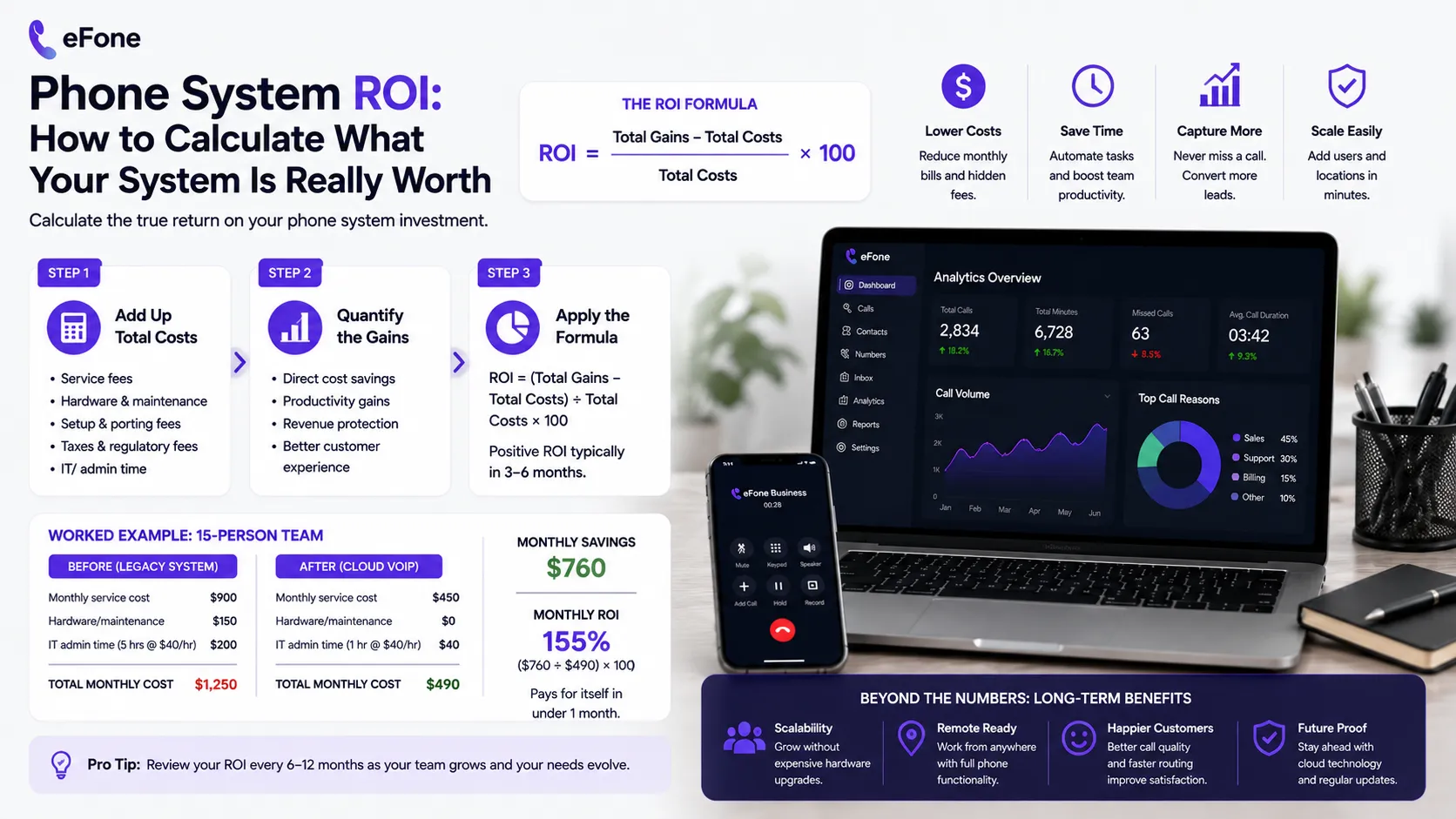
Worked Example: 15-Person Team Switching to Cloud VoIP
| Item | Before (Legacy System) | After (Cloud VoIP) |
|---|---|---|
| Monthly service cost | $900/month | $450/month |
| Hardware/maintenance | $150/month (amortized) | $0/month (softphone-based) |
| IT admin time | 5 hrs/month @ $40/hr = $200 | 1 hr/month @ $40/hr = $40 |
| Total monthly cost | $1,250 | $490 |
Monthly savings: $1,250 minus $490 = $760 in direct gains. Using the ROI formula: ($760 divided by $490) times 100 = 155% monthly ROI. Even before counting productivity or revenue gains, this team recoups its new phone system cost in under a month and keeps the remaining $760/month as pure savings going forward.
Common Mistakes That Skew ROI Calculations
- Comparing sticker price instead of total cost. A cheaper plan that demands more IT time often is not cheaper at all.
- Ignoring one-time setup and porting fees when comparing monthly costs
- Leaving out productivity gains entirely because they feel harder to quantify, even a rough estimate is more useful than no estimate
- Calculating ROI once and never revisiting it as usage, team size, or plan tier changes
Beyond the Formula: Benefits That Are Harder to Measure
Some benefits will not fit neatly into a spreadsheet, but they still affect your long-term return:
- Scalability: adding users or locations without a costly hardware overhaul protects future ROI
- Remote work support: teams can work from anywhere without sacrificing phone functionality
- Customer experience: clearer call quality and faster routing reduce repeat contacts and improve satisfaction
These are worth noting alongside your formula-based ROI, especially when presenting the case for a phone system upgrade to stakeholders.
How eFone Simplifies the ROI Case
Because eFone's plans are priced per user with no hidden add-on fees, most teams can build an accurate cost-side estimate in minutes rather than digging through a confusing invoice. You can compare your current phone spend against eFone's plans directly on the pricing page to see where your ROI would land.
For a full breakdown of what a modern system costs by team size, see our guide to business phone system cost, or read our deeper dive on VoIP cost savings for more real-world examples.
Frequently Asked Questions
What is the formula for phone system ROI?+
ROI = (Total Gains minus Total Costs) divided by Total Costs times 100. Gains include direct savings, productivity improvements, and revenue protected from fewer missed calls.
How long does it take to see ROI on a new phone system?+
Most businesses that switch to cloud VoIP see positive ROI within 3 to 6 months, with some worked examples showing payback in under a month once hardware and maintenance savings are included.
What counts as a cost in the ROI calculation?+
Recurring service fees, hardware, setup and porting fees, taxes, and internal IT or admin time spent managing the system all belong on the cost side.
Should I calculate ROI monthly or annually?+
Annual calculations are most common since they smooth out one-time setup costs, but you can use any period as long as costs and gains come from the same timeframe.
What is a good ROI for a phone system?+
There is no universal benchmark, but many businesses switching from legacy systems to cloud VoIP report ROI well above 100% once direct savings and productivity gains are combined.
The Bottom Line
Phone system ROI is not just a finance exercise, it is the clearest way to know whether your current system is earning its place in your budget. Run the formula with your real costs and gains, and you will usually find that a modern cloud VoIP plan pays for itself faster than expected. See eFone's plans on the pricing page to build your own ROI case.
Ready to get your number?
Set up a business phone and help desk on one account, or grab a personal line to call home — usually in minutes.
Get started